
Maybe some of you remember when you were a child and your parents (or siblings) would take you to your favorite place. The dirtiest, most colorful playground, or perhaps an amusement park filled with video games and candy shops. The first thing that comes to my mind is the excitement that would build days before the day. Nightdreaming, daydreaming, wondering how to speed up time.
As we grow up, hopefully that excitement doesn’t disappear, it just changes form. For me, it shifted towards nature. Places I had never visited, only heard of. And you would be right if you guessed that Velika Planina was one of them. :)
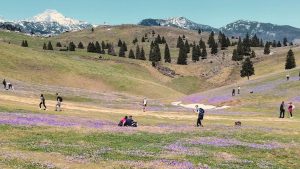
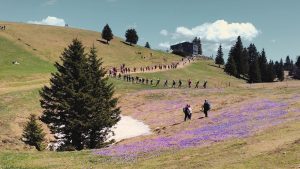
Years ago, I first saw it online. A mountain completely covered in purple flowers for a few short weeks in April. That was enough to put it straight onto my bucket list. This year, our hiking club (HPD Zaprešić) included it in the annual plan, and it quickly became the trip with the highest number of registered participants in the club’s history. It was clear we were heading somewhere special.
The excitement didn’t fade. A week before the trip, my body already knew by counting days, speeding up thoughts and heartrate. I even dreamed about it, or more precisely, about her – the mountain. I was watching it from above like a bird, transforming from white snow into fresh green, and finally flickering with islands of purple flowers, calling us in. People looked small, almost unreal, like Lilliputians moving across its lying body. A dreamy rhapsody that, this time, became reality.
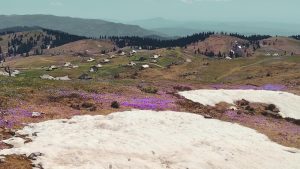
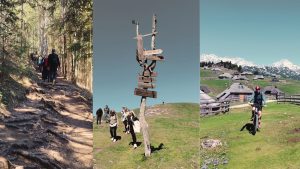
With two buses, almost 100 of us gathered in Zaprešić at 5:30 in the morning, aiming to reach Rakove Ravni parking (10€ daily ticket) before it got crowded. Our circular route was 12 km long with 560 m of elevation gain, passing through Mala Planina – Domžalski dom – the Chapel of Marija Snežna – shepherds’ huts – Gradišće peak (1667 m), and returning the same way. I would say it is the most popular route, relatively easy after the first kilometre of steep ascent from Jelšev konfin to Gojška planina. It’s not technically demanding, but due to its length it still requires good fitness, so bringing poles is a good idea. Near the Domžalski dom, it is possible to stop, eat a warm meal and sit outside with a beer, simply observing the landscape.
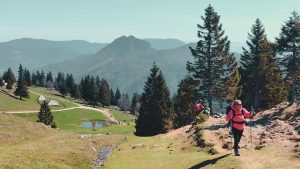
Velika Planina is known as a shepherd’s village with around 140 cottages. Some are traditional huts without electricity or water, while others have been transformed into modern tourist huts, powered by solar energy and equipped with saunas and contemporary interiors. At the Gradišće peak, there is also a cable car connecting the plateau with the western side, from Kraljev Hrib, where you can find parking. It adds another layer of accessibility, but also a contrast to the slow approach on foot.
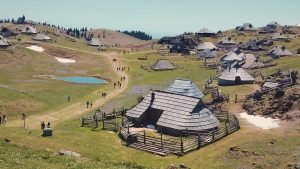
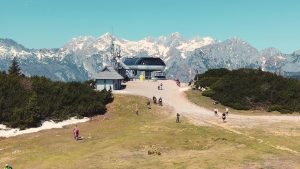
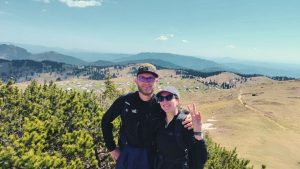
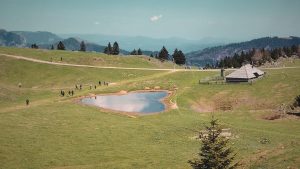
What surprised me most was the diversity of space along the way. At moments, the path passes through valley between rolling hills, scattered with small lakes reflecting the sky. Then suddenly, the horizon reveals an incredible view of the distant Alps, still covered in snow. If you’re lucky, you will see roes running up’n’down the hills or cows that have been brought to pasture. Along the plateau, the landscape changes every second and just before Domžalski dom I first noticed the mountain choughs, black alpine birds, moving and playing in groups, calling to each other with soft, very melodic sounds that somehow seemed familiar.
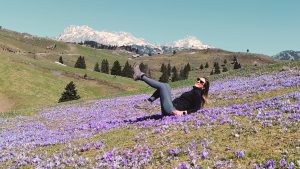
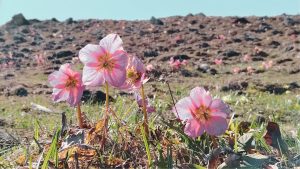
The saffron that covers the Kamnik–Savinja Alps belongs to a group of early spring flowers that appear as soon as the snow begins to melt. Their delicate purple petals often break through the last remains of snow. While on Mala and Gojška Planina they appear already in March, on Velika Planina the bloom comes later, in April. Although many associate this mountain with fields of daffodils, these saffron carpets are part of a natural ecosystem and play an important role in biodiversity. They are not the spice saffron (Crocus sativus), but a wild species Crocus vernus, the spring saffron. The name comes from the Greek krókos, referring to the yellow stamens, and Latin ver, meaning spring. Another flower that draws equal attention with its beauty is the pink hellebore (kukurijek), Helleborus.
In Greek mythology, saffron is connected to a love story. There are different versions, but they all speak of Crocus, a young mortal transformed into a flower because of his love for the nymph Smilax. In many cultures, saffron is seen as a messenger of spring, a symbol of awakening and new beginnings. And maybe that is why landscapes like this have such a quiet, almost meditative effect. Somewhere along the way, I had the feeling that I had stepped into a film set as everything was slightly unreal, perfectly composed, yet completely alive.
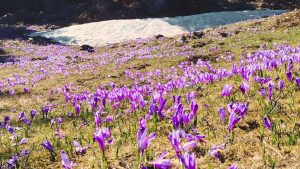
I rarely research about the places I visit. Maybe because I very much like getting lost ☺ or because I want to experience them without expectations. So it was only while writing this article that I came across the story of Crocus and Smilax, which now seems very funny but…At the very beginning of our ascent, I quietly said to Nikola: “I think I’m in love with saffrons… Today will be a true love story.”
And it was.
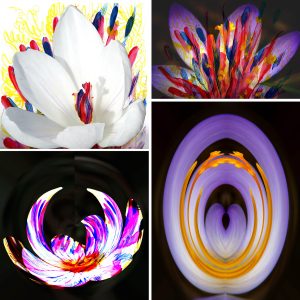
One of those places you carry with you for life, quietly staying with you for days, then searching for a way out through any possible medium. For me, this is what a truly fulfilling soul-hike experience feels like. So I thought it would be also nice to share some of the results with you, together with a short video I created (link). And if you are reading this in time, May is the season of white daffodils on the mountain, so you still have a chance to experience it this year. :)
About the Author: Josipa Slaviček



The photos are phenomenal! Thank you, Josipa!