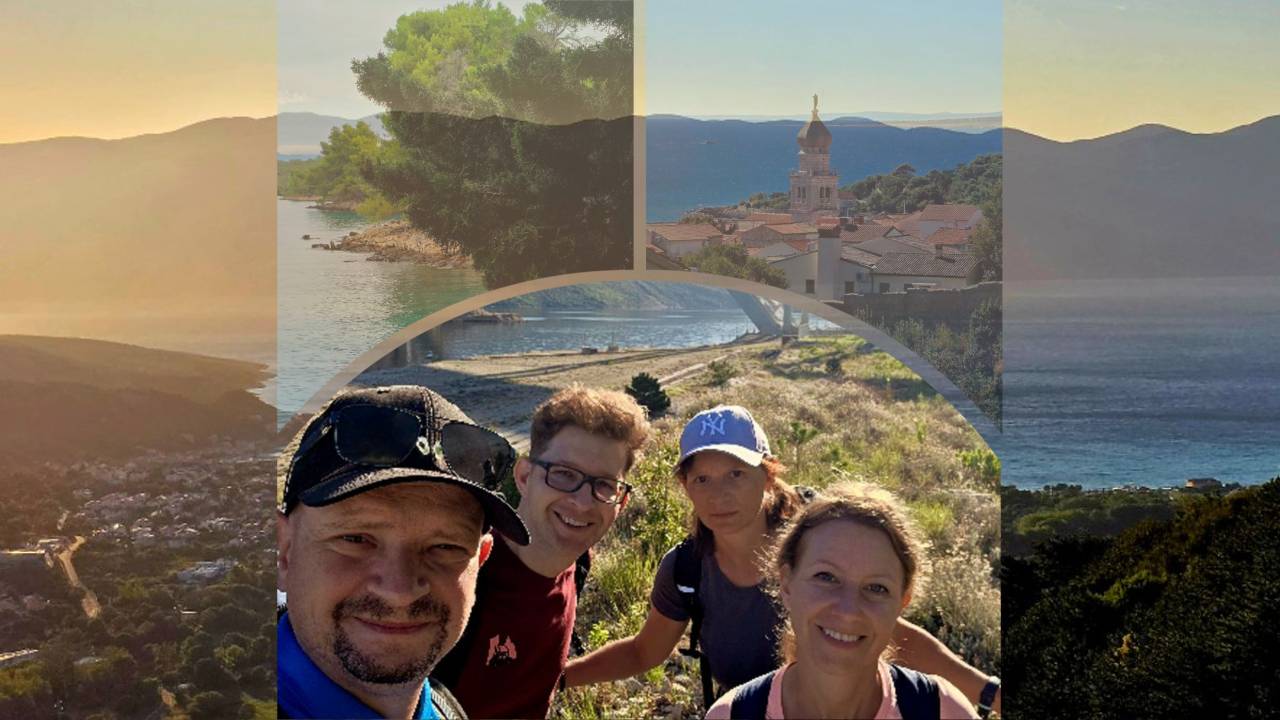
Camino Krk has been covered on this blog before, so there is no need for another grand discovery narrative. This is simply the next chapter: four friends who normally meditate together deciding, for reasons that seemed perfectly sensible at the time, to walk nearly 150 kilometers around Krk.
There are, of course, many ways to search for inner peace.
You can sit in silence, follow your breath, and watch your thoughts come and go.
Or you can set off on the Camino Krk with three friends and, after a few days, discover that enlightenment is actually the moment when somebody says:
“There’s an open pub over there.”
At first, walking with friends seemed like a considerable advantage. We imagined we would approach the journey calmly, mindfully and without unnecessary emotional reactions.
That theory survived until approximately the first wrong turn.
Krk–Brzac, or Why Follow the Official Route When There’s a Prettier One?
We started in the town of Krk.
The Camino was meant to send us toward Vrh, but it didn’t take long to discover a serious flaw in the plan: another trail, marked Adriatic, headed more toward Valbiska and promised considerably better views.
One is supposedly meant to learn acceptance on the Camino.
We began with disobedience.
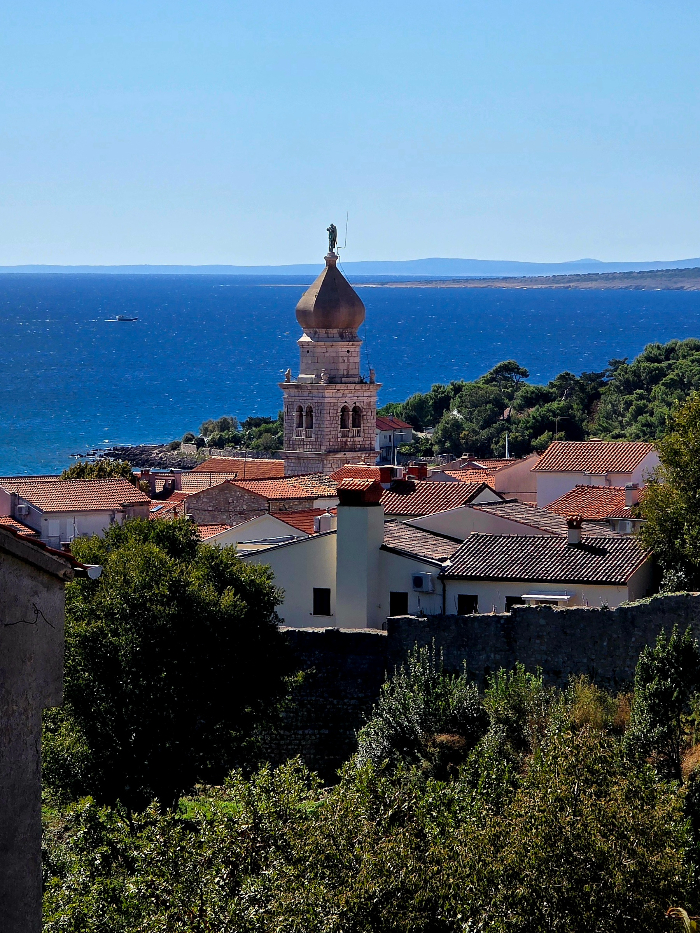
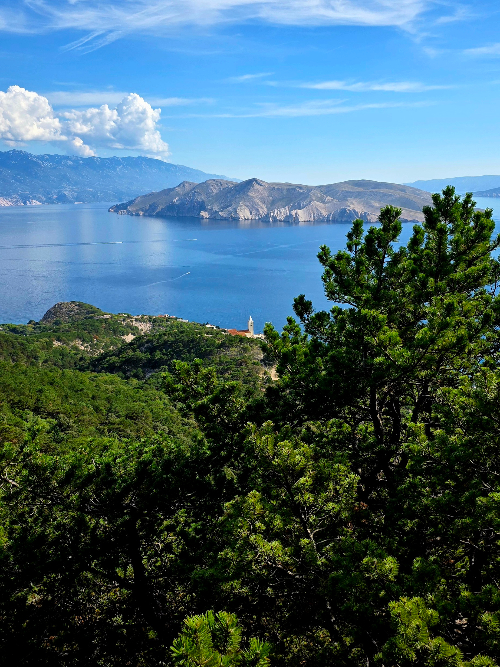
It proved an excellent decision. The sea opened up below us, the island of Plavnik lay in the distance, and the path was exactly the sort of trail that makes you forget that, sooner or later, you still have to walk all those kilometers.
We passed a wedding — and not some quiet, discreet country affair. We actually had to wait a while because somebody on a scooter was deliberately doing a burnout to produce enough smoke for the photographs.
The whole scene was so theatrical that, for a moment, it looked less like a wedding and more like a scene from a film about a Balkan mafia family: smoke, scooter, wedding guests, photographers, and the four of us standing to one side trying to work out whether this was part of the ceremony or merely a particularly imaginative use of a small motorcycle.
If we had imagined the Camino would be mostly about silence and inner peace, Krk quickly showed us it had more cinematic ideas.
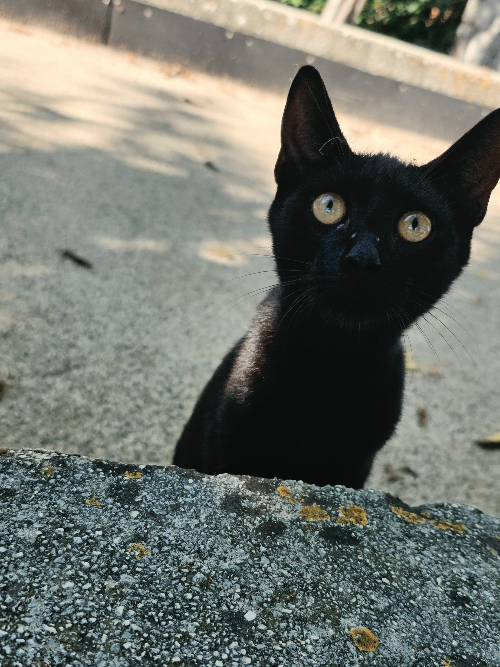
In Brzac, we stopped for another rest, and that’s when a young black cat joined us. At first, he behaved like a slightly reserved local observer of passing hikers. Then he noticed the food and immediately abandoned any pretense of feline dignity.
He ate with the enthusiasm of someone firmly convinced that the entire purpose of our Camino was to bring him lunch.
He sat beside us, took an active part in the meal, and through his remarkable ability to focus on what really mattered, reminded us of an important principle in life: a human being may contemplate the meaning of the journey, inner peace and spiritual growth, but a cat knows perfectly well that, at that particular moment, what matters is food.
Our car was waiting at the campsite, which extended our version of the official stage slightly. By the end, we had covered about 21 kilometers.
Which was just enough for half of the group to perform the purest form of meditation achieved that day: jumping into the sea.
The other half practiced a more advanced spiritual technique: regretting not having brought swimwear.
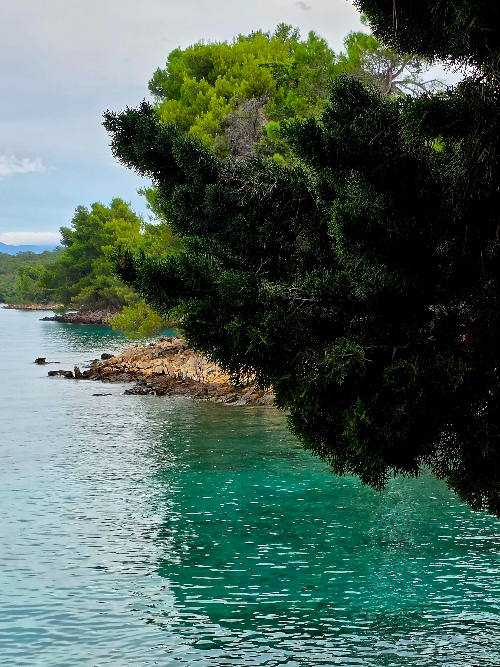
Vrbnik–Baška: Wine, a Stamp Without an Ink Pad, and Rather Too Much Sun
The next morning, we got up fairly early.
As we drove toward Baška, the mountains on the far side of the sea glowed orange. The sun was just rising, and the view was so beautiful that even our normal morning conversation was briefly reduced to:
“Look at that.”
For four friends, this is practically a vow of silence.
The logistics went suspiciously well. One car in Baška, another in Vrbnik. Nobody had been locked out of a vehicle on the wrong side of the island. The day was beginning with an almost alarming degree of organization.
Then came the stamp.
The Camino likes stamps. Hikers like stamps. A Camino passport without a stamp is rather like an ordinary passport without a border crossing.
In Vrbnik we found a magnificent stamp.
There was only one minor problem.
There was no ink pad.
We had the stamp. We did not have the ink pad. This reduced its usefulness considerably.
It was almost a Zen problem.
The sound of one hand clapping.
A stamp without ink.
For some time, we examined it, turned it over, pressed it against things, and generally did everything adults do when they know perfectly well something isn’t going to work but remain convinced there is a small chance it might if they try it just once more.
It didn’t.
Then we set off in the wrong direction.
Which was, in fact, a neat summary of the morning.
Once we finally started heading towards Baška, the characteristic landscape around Vrbnik opened up: vineyards, stone, sunshine, and the distinct impression that whoever arranged the hills of Krk had shown very little consideration for tired hikers.
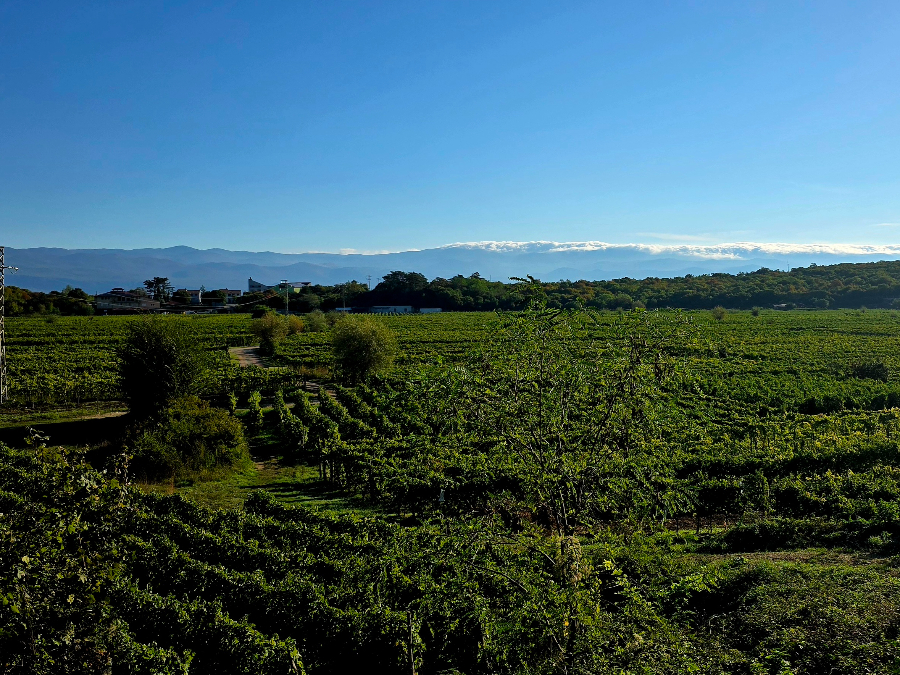
Vines to the left.
Vines to the right.
Vines below.
Wine later.
The route was beautiful and wonderfully varied.
It was also extremely hot.
We went up and down, and then up and down some more, until we had accumulated about 750 meters of climbing and a little over 23 kilometers.
But the views were extraordinary. Mountains, sea, bare karst slopes, vineyards behind us, and eventually the view down towards Baška and its bay.
Moments like these are one reason why a person voluntarily spends six hours walking over rocks.
The other is that the car is on the other side.
At the end, we performed another recovery ritual strangely absent from most traditional pilgrimage manuals: an enormous hamburger.
We also considered going for a swim.
Very seriously.
So seriously that we discussed it for several minutes.
Then we didn’t.
Malinska–Omišalj: Apples for Horses
One of the nice things about a Camino is that what you remember most clearly often has absolutely nothing to do with history, distance, or elevation gain.
On the Malinska–Omišalj stage, it was two horses.
We had apples.
The horses were interested.
Negotiations were brief.
The apples disappeared.
If, before setting off, we imagined we would be the ones searching for spiritual lessons on the Camino, the horses instead demonstrated that life can also be conducted according to a much simpler principle: if you see an apple, eat the apple.
No past lives.
No karmic analysis.
No inner conflict.
Enviable, really.
Baška–Kornić: From Forgiveness to a Wind With Personal Intentions
At the very first little church we came across, we saw a sign:
MY REVENGE IS FORGIVENESS.
A sentence like that makes you stop.
It was one of those moments when, for a few seconds, the Camino becomes what it is perhaps supposed to be.
Not sport.
Not Strava.
Not kilometers.
Not wondering whether the next five kilometers will be tarmac or rocks.
Just a sentence on a church and a few moments of silence.
Then someone asked:
“How far is it to the top?”
And spirituality reacquired GPS coordinates.
It later became apparent that this stage would be considerably less contemplative than its opening suggested.
At the end, Garmin reported: 22.7 kilometers. 959 meters of ascent.
Which is rather interesting, given that you start in a town by the sea and finish somewhere that is also notably not in the Himalayas.
So where did almost a thousand meters of climbing come from?
The answer is simple: up and down.
Repeatedly.
The most dramatic part came around Obzova, where the wind abruptly ceased to be a meteorological phenomenon and became an active member of the expedition.
It blew so hard it nearly carried one member of our group away.
Not metaphorically.
Actually.
For a few moments, we got an unexpected demonstration of the difference between hiking and sailing.
But as we were pilgrims rather than mountaineers, we found a sheltered spot and did what people eventually do on almost every difficult hike: we had lunch.
The wind howled a few meters away while we sat in the lee and ate.
Nature creates drama.
A man eats a sandwich.
Along the way we also met a group of Slovenian hikers. Among them was an older lady who gave the impression that she could quite happily walk around the world and, the following morning, ask in complete seriousness which way it was to the Moon.
She was one of those people who immediately make you realize that age is not a particularly useful piece of information.
Just another number somebody else keeps track of.
Omišalj–Čižići: Almost Lost Beneath Krk Bridge
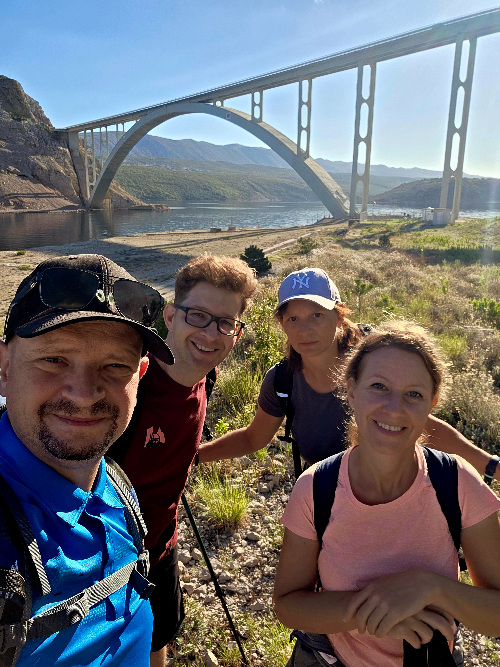
On the Omišalj–Čižići stage, somewhere beneath Krk Bridge, we experienced what can only be described as a very practical test of mindfulness.
We almost got lost.
Which is odd, because the bridge is quite large object.
You might assume that navigation becomes simpler underneath something that size.
It doesn’t.
There are a surprising number of ways to go the wrong way beneath a very large bridge.
At one point we stood there turning around, looking at phones, trail markers, the bridge and one another while engaging in that classic group-hiking activity: everyone had a slightly different theory.
And everyone was fairly confident theirs was correct.
It is, when you think about it, a very democratic way of getting lost.
Eventually, of course, we found the route.
One interesting thing about the Camino is that a wrong turn is usually just a slightly longer route.
Or occasionally a prettier one.
Dobrinj–Vrbnik: When 17 Kilometres Begins to Feel Like a Day Off
After several long days, 17 kilometers starts to sound almost like a rest day.
This shift in perspective is dangerous.
Before the Camino, I would have said: “Seventeen kilometers? Nice hike.”
After six days: “Only seventeen? Brilliant.”
The route from Dobrinj towards Vrbnik was varied, green and somewhat calmer.
After a little over four hours, we arrived in Vrbnik, where by now we were familiar with two things: wine. And a stamp that didn’t work.
People become attached to places for strange reasons.
The Last Day: Brzac–Malinska
For the final stage from Brzac to Malinska, there were only three of us.
Two members of our small hiking expedition had to go home earlier, so the last twenty-odd kilometers were walked by just two.
It changed the atmosphere slightly.
After six days of walking, conversation, wrong turns, wind, stamps, hamburgers and shared stops, the final stage was suddenly quieter.
The path led through the greener, more wooded part of Krk, past Glavotok, ancient oaks, the little Romanesque church of St Chrysogonus, and on towards Porat and Malinska.
In a week, Krk had shown us almost all its faces.
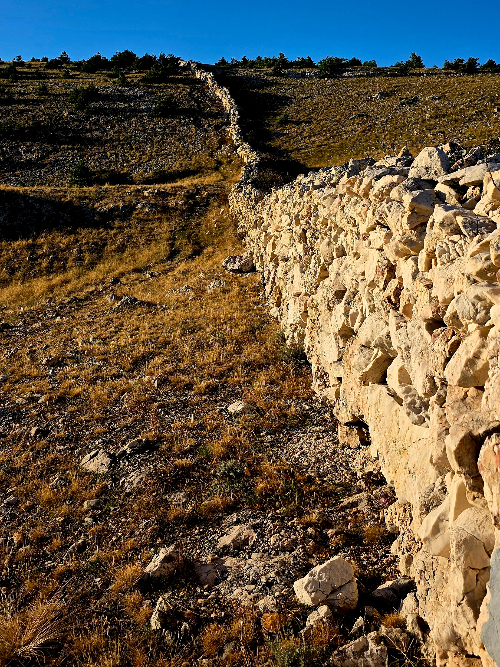
Bare rock above Baška.
The vineyards of Vrbnik.
The forests of the western part of the island.
Old towns.
Tiny churches.
Monasteries.
The sea appearing between the trees precisely when you are not expecting it.
On the final day, Garmin stopped at 21.47 kilometers.
Two of us reached the end, but the finish still belonged to all four of us.
Because a Camino is not really just the last few kilometers.
It is everything you walked together before them.
And then, suddenly, there was no next stage.
Which felt almost strange.
The Final Reckoning
In the end, the number of kilometers, the meters of ascent, the countless steps didn’t really matter.
What remains are other things.
Orange mountains in the early morning.
A black cat in Brzac eating with great enthusiasm.
Two horses and two apples.
A stamp without an ink pad.
A selfie.
Four people almost getting lost underneath an enormous bridge.
The wind on Obzova trying to reduce our party from four to three.
Lunch in the shelter of the rocks.
An elderly lady who looked capable of walking around the world and then asking for directions to the Moon.
An enormous hamburger.
A sore big toe.
Sandals.
And the words: My revenge is forgiveness.
The four of us normally met to sit still together.
Then we decided to walk together.
Perhaps the two things are not so different after all.
In meditation, you sit for long enough that you stop running away from your thoughts.
On the Camino, you walk for long enough that your thoughts gradually stop seeming quite so important.
Then there are only footsteps.
The sea.
The wind.
The stones.
Friends beside you.
And the most important question of the day:
“Is there anywhere around here to get something to eat?”
About the Author: Mirica